The Kosmos Innovation Center (KIC) celebrated a major milestone in its School Farm Programme, with participation rising to more than 700 schools across all 16 regions, reflecting growing national interest in practical agriculture and youth entrepreneurship.
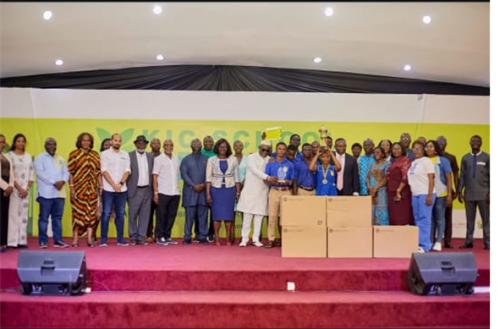
Speaking at the 2025 KIC School Farm Awards Ceremony held Friday, November 22, at the Kwame Nkrumah University of Science and Technology (KNUST) Great Hall, Executive Secretary Benjamin Gyan-Kesse said the initiative is transforming how young people perceive agriculture by making it accessible, relevant and financially rewarding.
The programme, which began as an experiment to make farming appealing for students, has evolved into a nationwide model for hands on learning. It equips young people with practical agricultural skills alongside entrepreneurial competencies such as record keeping, marketing strategies and basic business planning.
Gyan-Kesse noted that students across Ghana are learning through direct experience, developing new perspectives and discovering pride in agricultural work. KIC supports all participating schools with inputs including seeds, fertilizers and tools, while providing technical guidance through consultants and trained teachers.
The strong uptake from over 450 schools last year to more than 700 this year demonstrates a significant mindset shift among young Ghanaians, according to the executive secretary. He emphasized that more than 700 participating schools represent a wave of young people gaining confidence, problem solving abilities and leadership skills through agricultural practice.
Gyan-Kesse expressed gratitude to programme partners, the Mastercard Foundation and the Blue Skies Foundation, calling on additional private sector players, development agencies and district assemblies to expand the initiative, particularly in areas such as irrigation systems and agricultural technology support for schools.
Nana Joe Mensah, Board Chair of KIC, praised the programme as one of the country’s most transformative youth initiatives, rooted in collaboration between government, development partners and the private sector. Each school farm represents a model of practical education where science, teamwork and innovation converge, he added.
Mensah expressed the board’s commitment to strengthening partnerships and scaling the programme to ensure every school in the country can use agriculture as a tool for experiential learning. The expansion would deepen agricultural education’s integration into Ghana’s educational system.
Deputy Director of the Ghana Education Service (GES), Dr. Munawaru Issahaque, speaking on behalf of Director-General Prof. Ernest Kofi Davis, stressed that agricultural education remains a strategic priority for the service. It addresses youth unemployment, supports rural transformation and enhances national food systems.
The GES plans to deepen partnerships with KIC, the Mastercard Foundation and the Blue Skies Foundation to expand the programme’s reach to more districts and schools. Dr. Issahaque announced intentions to integrate more farm based learning into the national curriculum, strengthen school farm infrastructure, particularly water systems, and expand agribusiness oriented extracurricular activities.
The deputy director acknowledged the crucial role of teachers and school coordinators, describing them as architects of educational change. Their innovation and dedication empower students and strengthen entire communities through agricultural education, he noted.
Addressing students, Dr. Issahaque said their creativity, perseverance and determination make them the heartbeat of the programme and future innovators capable of shaping Ghana’s agricultural landscape. The school farm competition could empower students to go beyond planting crops to cultivate critical thinking, resourcefulness, teamwork, and skills to turn ideas into tangible results.
The 2025 awards ceremony operated under the theme “Rethinking Agriculture: Growing Young Minds to Feed Ghana’s Future.” The theme reflects efforts to reframe farming from a perceived burden to a vibrant, profitable, and technologically viable career path for young Ghanaians.
Over 1,000 schools, including institutions serving students with special needs, applied to participate in the 2025 competition, according to programme data. This overwhelming interest indicates the positive impact the initiative has generated among educational institutions nationwide.
Judging criteria evaluated multiple dimensions beyond simple agricultural output. Assessors examined the quality and yield of farm produce, consistency of best agricultural practices, innovation in farming techniques, and the strength of business plans developed by student participants.
KIC officers visited participating school farms throughout the year to award marks based on vegetable quality and effectiveness of farming practices. Additionally, students faced evaluation on how the programme contributed to promoting agriculture among young people in their schools and communities.
Winners for the 2025 KIC School Farm Awards received desktop computers, certificates of participation, plaques, trophies and medals. The recognition aims to celebrate excellence while encouraging continued engagement with agricultural education and entrepreneurship.
The overall best Senior High School award went to St. John’s Grammar School located in Accra. Students from Holy Cross Seminary in the Oti Region won the first runner up position. Nyinahin Catholic Senior High School and St. Joseph’s Senior High Technical School claimed second and third runner up positions respectively.
For the basic school category, Gbulahagu District Assembly Junior High School in the Northern Region emerged as overall winners. Okanta District Assembly Basic School came in as first runner up, with Asawinso Methodist B and Anyinam District Assembly Girls’ Model School claiming second and third runner up positions respectively.
The 2024 edition saw Tamale Girls Senior High School and Okanta Presbyterian Basic School win overall best SHS and JHS awards respectively. These past winners stand as examples of the programme’s success in cultivating agricultural interest and entrepreneurial thinking among Ghanaian students.
The programme provides specialized training on practical agricultural concepts. Students learn about nursing seedlings, transplanting techniques, cultivation bed preparation, proper application and use of approved chemicals and fertilizers, and the use of personal protective equipment in farming operations.
The School Farm Competition forms an integral part of KIC’s strategy to promote practical agricultural education and enhance entrepreneurial potential among students across Ghana. The initiative addresses the broader organizational goal of raising a generation of agricultural entrepreneurs who understand agriculture’s importance in sustaining livelihoods and contributing to national development.
KIC, a youth leadership and entrepreneurship training center, focuses on increasing awareness of agricultural opportunities and associated entrepreneurial benefits for young people. The organization’s projects provide support to youth ranging from high school students to medium scale business owners.
The Blue Skies Foundation initially launched the school farm initiative, with KIC assuming full management and operational responsibility as of 2024. This transition enabled KIC to scale the programme significantly while maintaining quality standards and expanding geographic reach across all regions.
The Mastercard Foundation’s partnership with KIC provides crucial financial and technical support enabling the programme’s expansion. The foundation’s involvement reflects broader commitments to youth development, skills training and economic opportunity creation across Africa.
The programme aligns with growing recognition that agriculture offers viable career pathways for young Ghanaians. Despite agriculture employing significant portions of the population, particularly in northern regions where the sector engages approximately 66.7 percent of people according to the 2021 Ghana Living Standards Survey, youth participation remains limited.
Factors contributing to low youth engagement include reliance on rudimentary tools and farming methods, low adaptation to climate change, minimal innovation uptake, and persistent negative perceptions about farming as a career. The KIC School Farm Competition directly addresses these challenges by demonstrating modern, technology enabled agricultural practices.
The programme emphasizes Science, Technology, Engineering and Mathematics (STEM) education through experiential learning. Students apply theoretical agricultural knowledge in practical settings, improving their skills while developing understanding of how scientific principles operate in real world farming contexts.
Programme objectives include changing negative perceptions about agriculture that have developed in Ghana over recent decades, spreading farming culture among young people, encouraging students to consider careers along the agribusiness value chain, developing positive attitudes about food systems, the environment and entrepreneurship, and encouraging educational system reforms to include compulsory agricultural courses in first and second cycle schools.
The expansion to more than 700 schools represents progress toward these objectives. However, organizers acknowledge that achieving system level transformation requires sustained effort, increased resources, and continued partnership between government, private sector, civil society and educational institutions.
Agricultural education advocates argue that practical farming programmes offer multiple benefits beyond individual student development. They contribute to food security, rural economic development, youth employment generation, and environmental sustainability when implemented effectively.
The 2025 awards ceremony reinforced commitments from stakeholders to continue expanding and improving the School Farm Programme. The gathering brought together representatives from education, agriculture, government, development partners and the private sector to celebrate achievements while planning future programme enhancements.
Source: NewsGhana.com