The Ministry of Food and Agriculture has distributed 40,000 bags of inorganic fertilisers, five agricultural drones, and nearly 8,000 cartons of organic fertilisers to farmers across the country as part of efforts to strengthen food production and reduce dependence on imports.
The distribution took place at a ceremony held at the Ministry’s forecourt in Accra on Tuesday under the Feed Ghana Programme, a government initiative aimed at improving agricultural productivity and ensuring food security.
Speaking at the event, the Minister for Food and Agriculture, Hon. Eric Opoku, said the intervention goes beyond the supply of inputs and reflects a broader national commitment to agriculture.
“We are not merely distributing agricultural inputs,” he said. “We are affirming that the Ghanaian farmer is central to national development, and that transformation begins from the soil.”
The 40,000 bags of fertiliser were handed over to the Peasant Farmers Association of Ghana for onward distribution to member farmers, particularly those who may not benefit from district-level allocations. The Minister added that additional supplies will be distributed nationwide through district agricultural offices in the coming days, alongside support for registered institutions under the programme.
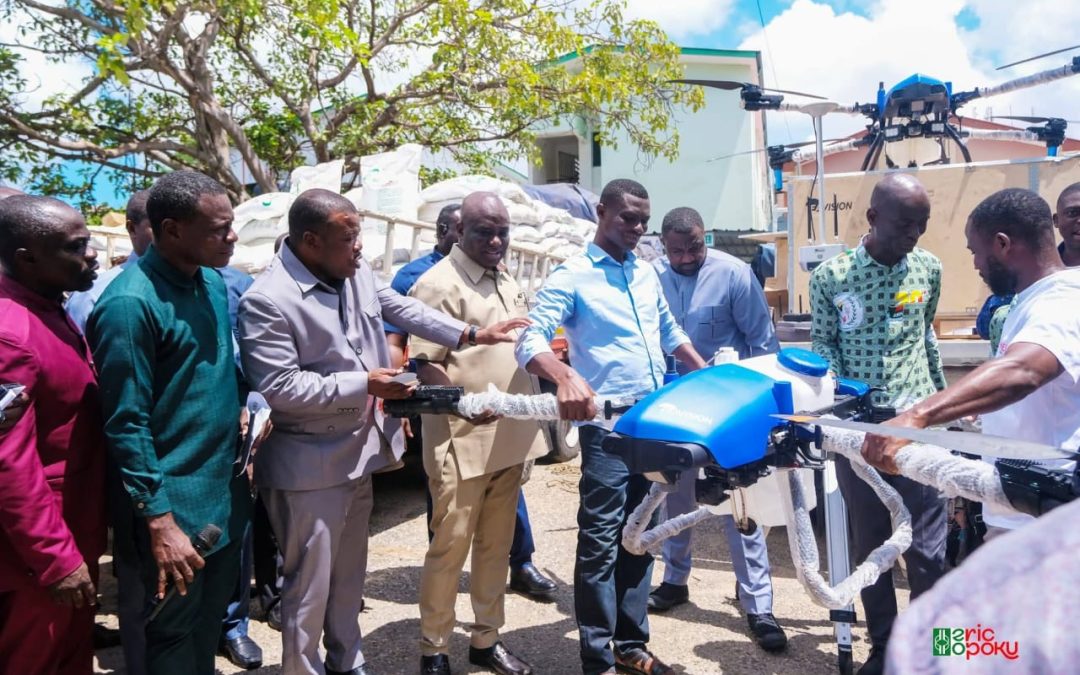
Five agricultural drones were also presented to the association to support modern farming practices. The equipment is expected to help farmers monitor crop health, detect pests and diseases early, and improve farm management decisions.
Mr. Opoku noted that agriculture is evolving beyond traditional methods, stressing the role of technology in the sector.
“The future of agriculture will not be built only with the hoe and cutlass,” he said. “It will also depend on data, drones, improved seeds, fertilisers, irrigation, mechanisation, and precision farming.”
He added that modernising agriculture is also key to attracting young people into the sector by making farming more efficient and commercially viable.
The Ministry also distributed 7,936 cartons of organic fertilisers to selected cooperatives and irrigation schemes, including groups in Abokobi, Adenta, Michel Camp, and the ICOUR Tono Irrigation Scheme. The remaining 6,500 cartons will be allocated to farmers in southern Ghana ahead of the upcoming minor farming season.
He further explained that the Feed Ghana Programme is designed to address several national priorities, including food price stability, import reduction, job creation, and industrial development.
“Increased production will not come from speeches alone,” he said. “It depends on timely access to inputs and strong coordination across irrigation, mechanisation, extension services, finance, markets, and agro-processing.”
The programme forms part of government’s broader efforts to modernise agriculture and build a more resilient and self-sufficient food system.