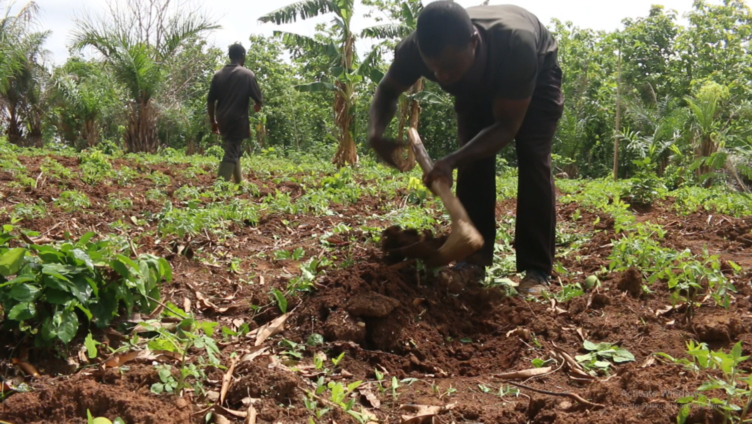
Agricultural analyst Dr Joseph Opoku Gakpo has urged the government to prioritise agricultural extension services, saying stronger support for extension personnel is essential to helping farmers adopt innovations and improving food security in Ghana.
Speaking in an interview to mark World Food Day on October 16, Dr Gakpo said investment in agricultural research would have limited impact if farmers did not receive clear communication about innovations and could not translate them into practical solutions.
This year’s World Food Day theme, “Innovate today. Nourish tomorrow,” highlighted the role of science and innovation in building sustainable food systems and ensuring food security for future generations.
World Food Day is observed annually to commemorate the founding of the United Nations Food and Agriculture Organisation (FAO) in 1945.
The occasion raises awareness of hunger and malnutrition and promotes efforts to build sustainable and resilient agrifood systems.
“If we want to boost innovations in our food systems, we must invest adequately in agricultural extension personnel and the systems that support their work.
“Without effective extension services, innovations developed at universities and research institutions may never reach the farmers who need them, limiting the benefits of investments in agricultural research,” Dr Gakpo said.
He stressed that extension personnel need technical knowledge of crop and livestock production, soil health, pest management, post-harvest management and marketing, and other sustainable farming practices.
But they must also possess strong communication and other soft skills to explain scientific concepts clearly and build trusting relationships with farmers.
“Communicating scientific information effectively is important. And so is building trust. Whether we are introducing regenerative farming practices, genetically modified organisms, or improved post-harvest management techniques, farmers need to understand the technologies and trust the people introducing them. Without that trust, adoption can be difficult,” he said.
Dr Gakpo cited research he co-authored with Dr Katherine McKee, an associate professor in the Department of Agricultural and Human Sciences at North Carolina State University, USA, which identified trust as an important determinant of technology acceptance, to back his point.
The study, titled “How Do Scientists Promoting Genetically Modified Seeds in Africa Build Trust? The Experience of Ghanaian Farmers,” was published in the Journal of International Agricultural and Extension Education.
The study, which interviewed farmers in Ghana’s three northern regions, recommended that institutions “seeking to introduce farmers to new technologies use intermediaries the farmers trust… communicate effectively, encourage peer validation, and build collaborative relationships.”
Call for greater investment in extension services
Agricultural extension services bridge the gap between research and farming practice by providing farmers with information, training, technical advice and access to innovations.
In Ghana, the Ministry of Food and Agriculture (MoFA), through its Directorate of Agricultural Extension Services and regional and district structures, plays a central role in coordinating these activities.
Dr Gakpo called for deliberate and sustained investment in the country’s extension system, arguing that inadequate staffing limits the support available to farmers.
“Ghana has approximately one agricultural extension officer for every 1,700 farmers, compared with the FAO’s recommended ratio of about one officer to about 500 farmers.
Although the appropriate ratio may vary depending on the context, the gap highlights the need for more extension personnel and better working conditions for them,” he said.
“Investing in these systems can help ensure that agricultural innovations translate into improved production, better market access and stronger livelihoods,” he added.
Dr Gakpo also described the proposed Agricultural Extension and Advisory Services Bill currently being championed by the Ministry of Food and Agriculture as an opportunity to strengthen the delivery and regulation of extension services in Ghana.
The government said the bill aims to modernise extension service delivery and establish a clear legal and regulatory framework for agricultural extension and advisory services nationwide.
According to Dr Gakpo, provisions for professional oversight and regulating service providers could improve the quality and accountability of extension services.
“The proposed bill includes measures to establish a National Agricultural Extension and Advisory Services Council to regulate extension professionals and oversee standards and training.
“It also proposes a regulatory unit to monitor and evaluate organisations providing extension and advisory services. These measures could strengthen professionalism and service quality, ensuring that farmers receive more effective support,” he said.
Final word on World Food Day
Dr Gakpo said World Food Day should remind us to ensure everyone in Ghana has access to sufficient, nutritious food. Citing figures from the Ghana Statistical Service, he said a significant proportion of the population still faces food insecurity despite progress in the agricultural sector.
“Available figures indicate that about 10 per cent of Ghana’s population remains food insecure. My hope is that, by the time we mark World Food Day next year, that figure will have declined considerably,” he said.
He called for strengthening food systems beyond the focus on increasing production. “Food security is not just about how much food we produce.
“We must also ensure that food is available, accessible and affordable to everyone. Food is a basic human right, and everyone deserves the opportunity to access it,” Dr Gakpo said.
Source:https://www.myjoyonline.com