Jun 26, 2026
The government, through the National Food Buffer Stock Company (NAFCO), has registered 45 accredited Licensed Buying Companies (LBCs) to purchase grains, particularly maize and rice, from farmers in major producing areas across the country.
The Deputy Minister of Food and Agriculture, Mr John Dumelo, who disclosed this, said the move formed part of efforts to address the current glut of maize and rice on the market.
Mr Dumelo made the statement on the floor of Parliament last Thursday while responding to an urgent question on the grain glut and measures being taken to resolve the situation.
He explained that the involvement of the LBCs in purchasing grains from farmers would help reduce post-harvest losses and stabilise prices.
The Deputy Minister said the government was addressing the glut through a mix of direct purchasing, processing, storage and other interventions under the Feed Ghana programme.
He warned that failure to tackle the situation could discourage farmers from continuing the production of rice and maize.
Rice
Mr Dumelo further indicated that the Ministry of Food and Agriculture, in collaboration with donor partners, was strengthening the country’s food systems and infrastructure through the refurbishment of storage warehouses and the procurement of equipment.
He said these measures would expand storage capacity and enable NAFCO to purchase and store larger quantities of food grains.
As part of long-term strategies to prevent future gluts, Mr Dumelo disclosed that the government was establishing five new maize-processing factories across the country to shift the focus from storage to value addition.
He also noted that a government directive requiring state institutions to prioritise the purchase of locally produced rice and maize would help absorb excess production.
According to him, the interventions being implemented by the Ministry underscore the government’s commitment to resolving the challenges facing rice and maize farmers.
BY BENJAMIN ARCTON-TETTEY
Source:Ghanaian Times
Jun 25, 2026
The Peasant Farmers Association of Ghana (PFAG) has asked the government to engage fertiliser manufacturers and suppliers to reduce market prices, warning that free fertiliser distributions alone will not meet the needs of the country’s millions of farmers.
The call follows the Ministry of Food and Agriculture’s recent distribution of 40,000 bags of inorganic fertiliser and five agricultural drones to PFAG under the Feed Ghana Programme to support smallholder farmers and boost agricultural productivity.
Speaking to Citi Business News, Executive Director of PFAG, Bismark Nortey, welcomed the intervention but stressed that the quantities available remain inadequate relative to demand.
“We know that the policy for the government this year, when it comes to fertilisers is free distribution. However, there’s a challenge because not all farmers will be able to access it,” he said.
He noted that PFAG’s membership alone ranges between 500,000 and one million farmers, making it impossible for the current allocation to satisfy demand.
“If you’re having 40,000 bags, you can’t even supply all,” he noted.
Nortey explained that while district agricultural offices and constituencies are also receiving fertiliser allocations, the overall volumes available are still insufficient when compared to Ghana’s estimated farming population of about three million people.
“We are looking at around three million people, and you can imagine the burden on government coffers if you have to supply over three million bags of fertiliser,” he said.
To address the gap, PFAG is proposing a complementary strategy that would make fertiliser more affordable for farmers who are unable to benefit from the free distribution programme.
“What I would encourage the ministry to do, in addition to this gesture, is to find a mechanism to ensure that they engage these fertiliser companies to reduce the prices so that farmers who are not able to access any of the free fertilisers can at least buy them on the market at reduced prices,” Nortey stated.
He argued that lower fertiliser prices would provide relief to farmers grappling with market challenges, produce gluts and limited access to capital.
“We all know the challenges that our farmers are facing regarding the markets, glut and the fact that they are unable to raise enough capital,” he added.
Jun 25, 2026
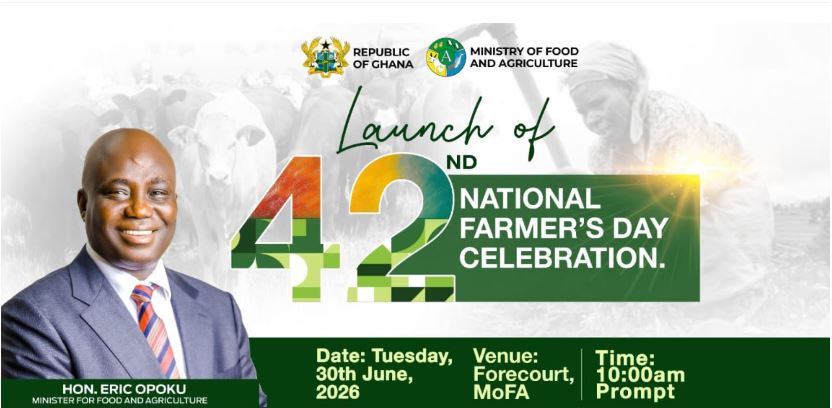
The Ministry of Food and Agriculture is pleased to invite Corporate Ghana, Development Partners, Donor Agencies, Financial Institutions, Agribusinesses and other key stakeholders to the official launch of the 42nd National Farmers’ Day Celebration.
The launch will take place on Tuesday, 30th June 2026, at 10:00 a.m. at the forecourt of the Ministry in Accra.
For over 40 years, the National Farmers’ Day Celebration has been Ghana’s major platform for recognizing and celebrating the hard work, innovation and contribution of farmers, fishermen, agricultural workers, agribusinesses, researchers and institutions that continue to drive the growth of the agricultural sector.
This launch would officially kick-start activities leading to the 2026 national celebration. The Ministry will unveil the theme for the 42nd edition, announce the host region, outline the programme of activities and provide details on award categories and other key arrangements.
The event will also highlight sponsorship and partnership opportunities for valued organizations interested in supporting Ghana’s agricultural development agenda. It offers a valuable platform for stakeholders to engage directly with the Ministry and explore areas for collaboration towards a successful and impactful celebration.
As Ghana continues to pursue sustainable agricultural growth, food security, job creation and value addition, the Ministry recognizes the important role played by the private sector and development partners. Your support does not only honor the efforts of farmers and value chain actors but also contributes to building a stronger and more resilient agricultural sector.
The Ministry therefore encourages all organizations and partners to attend the launch and take advantage of the opportunities for engagement and partnership.
Together, let us celebrate the individuals and institutions whose efforts continue to feed the nation and drive agricultural transformation in Ghana.
Issued By:
Public Relations Unit
Ministry of Food and Agriculture
Jun 24, 2026
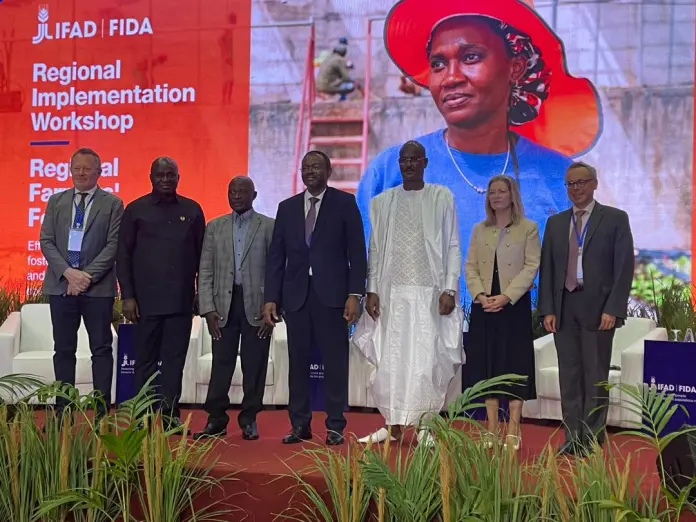
Ghana’s Minister for Food and Agriculture, Eric Opoku, has underscored the importance of collaboration between governments and development partners in transforming agriculture and improving rural livelihoods across Africa.
Ghana economic analysis
Speaking as Special Guest of Honour at the JLIFAD/FIDA Regional Implementation Workshop and Regional Farmers’ Forum in Abidjan, Côte d’Ivoire, the minister joined fellow Ministers of Food and Agriculture, policymakers, development experts and farmer organisations from West and Central African countries, including Nigeria, Mali, Burkina Faso, Senegal, Cameroon, Sierra Leone and Côte d’Ivoire.
The forum was held under the theme: “Efficient Delivery, Fostering Innovation and Scaling Up Operations for Greater Impact in West and Central Africa.”
During a high-level panel discussion involving Ministers of Food and Agriculture, Mr. Opoku responded to questions regarding the contribution of the International Fund for Agricultural Development (IFAD) to Ghana’s agricultural sector and the rationale behind the government’s free fertilizer intervention for smallholder farmers.
He described Ghana’s partnership with IFAD as a model of successful rural development, highlighting the achievements of the Rural Enterprises Programme (REP).
According to the Minister, the programme helped establish a nationwide ecosystem for rural enterprise development by providing credit facilities, matching grants, and access to investment capital through partnerships with local financial institutions.
Insurance comparison tool

“Through this programme, thousands of rural entrepreneurs gained access to investment capital, enabling them to grow their businesses and create employment opportunities,” he said, adding that more than 200,000 households benefited from the initiative, with women constituting a significant proportion of beneficiaries.
The minister also outlined government’s efforts under the Feed Ghana Programme, which aims to strengthen food security and support agro-processing industries through increased local production.
He noted that post-harvest losses remain a major challenge, accounting for approximately 30 percent of agricultural produce and costing Ghana an estimated US$1.9 billion annually.
“The PROSPER Programme is complementing government efforts to improve production methods and post-harvest management in order to reduce these losses and increase productivity,” he stated.
The Minister further explained that the devastating droughts, floods and other climate-related disasters experienced in 2023 and 2024 exposed vulnerabilities within Ghana’s food systems, prompting a shift from predominantly rain-fed agriculture to irrigation-based farming.
He revealed that the government is collaborating with the PROSPER Programme to expand irrigation infrastructure, particularly small-scale irrigation facilities targeting smallholder farmers, women, and rural youth.
Touching on proposals for solar-powered irrigation systems, Mr. Opoku welcomed the recommendations and expressed Ghana’s readiness to work with stakeholders to develop a sustainable and efficient irrigation strategy that aligns with the country’s agricultural transformation agenda.
Ghana economic analysis
Addressing concerns that the government’s free fertiliser distribution programme could conflict with market-based agricultural policies, the Minister clarified that the intervention was introduced as a temporary emergency measure rather than a permanent policy.
“Following the droughts, floods, and other disasters that affected our farmers, many lost their investments and livelihoods. Government had to provide an emergency cushion to support these farmers, stabilise food production, and help contain food inflation,” he explained.
He stressed that the programme was designed to help farmers recover from climate-related shocks and ensure continued food production.
He further announced that the government is establishing Farmers’ Service Centres across the country to provide mechanisation services, subsidised inputs, extension services, and other critical support to farmers.
According to him, these centres will strengthen farmer participation, improve productivity, and contribute to the modernisation of Ghana’s agricultural sector.
He emphasised that effective policymaking requires continuous monitoring, evaluation, and adaptation to changing circumstances.
“Had government not intervened with emergency measures, food inflation would likely have continued to rise. Today, however, we are beginning to see positive results as inflationary pressures ease and agricultural production recovers,” he said.
The regional forum provided an opportunity for participating countries to share experiences, exchange innovative ideas, and strengthen partnerships aimed at accelerating agricultural transformation, improving food security, and enhancing rural livelihoods across West and Central Africa.

Jun 24, 2026
The United Nations World Food Programme (WFP) has graduated its first cohort of 70 young innovators under the inaugural CODE4FOOD Security Fellowship Programme aimed at equipping participants with advanced digital skills to support food security and sustainable agricultural development.
The programme provided the fellows with five months of intensive training in data analytics, artificial intelligence, machine learning and digital innovation, enabling them to develop practical solutions to challenges within Ghana’s food systems and drive innovation in agriculture.
The graduation on Friday , formed part of the CODE4FOOD Security Programme Demo Day organised by WFP in partnership with the Korea International Cooperation Agency (KOICA), the Ministry of Communication, Digital, Technology and Innovations (MoCDTI), and Blossom Academy in Accra.
The fellowship graduated the first cohort of young innovators under the programme, which seeks to empower youth with technology driven solutions while supporting ghana’s digital agenda
Speaking at the event, the Country Director of WFP Ghana, Aurore Rusiga, said innovation and technology were critical to building food systems that were efficient, inclusive, sustainable and resilient to shocks.
According to her, Ghana’s food systems continued to face interconnected challenges, including unpredictable weather patterns, market inefficiencies, post harvest losses, rising production costs and limited access to timely information.
Businessopportunities Ghana
She said such challenges required a rethinking of how agricultural produce was produced, stored, processed, transported and marketed, stressing that young people must play a central role in transforming the sector.
“These realities demonstrate why young people, with their creativity, energy and familiarity with technology, must be at the heart of the transformation,” she said.
Ms Rusiga commended the participants for successfully completing the intensive programme, describing their achievement as a reflection of discipline, commitment and determination.
She also praised Blossom Academy, trainers, mentors and technical experts for delivering a rigorous and industry relevant training programme that prepared participants for opportunities within the digital economy.
Ms Rusiga said the projects demonstrated the participants’ ability to translate knowledge into practical solutions capable of strengthening food systems, improving livelihoods and enhancing agricultural productivity.
The WFP Country Director assured that WFP and its partners would continue to create pathways for graduates to access employment and entrepreneurial opportunities.
She expressed appreciation to the government of the Republic of Korea and KOICA for supporting the initiative, noting that their investment would strengthen Ghana’s capacity to harness digital innovation for food security and sustainable development.
Ms Rusiga encouraged the graduates to continue upgrading their skills, adapt to emerging technologies and apply their knowledge responsibly to help build a future ready workforce capable of transforming agriculture and strengthening food security in Ghana.
Businessopportunities Ghana
The fellows developed capstone projects that applied digital technologies to address food security challenges, including post harvest losses, market inefficiencies and limited access to agricultural data.
The projects were showcased during the event and assessed by a panel of judges and stakeholders, after which outstanding participants were recognised with awards in various categories.
According to the stakeholders, 16 participants had secured employment before the formal completion of the fellowship, demonstrating the programme’s strong link between digital skills development and job creation.
BY STEPHANIE BIRIKORANG