Apr 11, 2025
Management and Staff of the National Food Buffer Stock Company (NAFCO) have been sensitized on the Right To Information Act.
It was organized by the Corporate Affairs Department of the company and the RTI Unit with resource persons from the Access to Information Division of the Information Services Department. The purpose of the program was to deepen the awareness of the Right to Information Act among staff of the company.
The training had resources persons from the Access to Information Division of the Information Services Department, namely Madam Bridget Mensah (Head, Access to Information Division), Mr. Sostheness Senanu Nyadroh and Mr. George Basoah Frimpong, both Deputy Chief Information Officers at the Information Services Department.
Mr. George Abradu-Otoo, the Chief Executive Officer at the Company, in his welcome address thanked the resource persons for taking some time off their busy schedule to help sensitize staff and management on the various provisions prescribed in the RTI Act
The resource persons in turns took participants through, the general background of the RTI Act, merits of the Law, duties of public institutions in relation to the RTI Act, the processes and timelines involved in applying for information, the review mechanisms and the exemptions outlined in the RTI Act.
Madam Bridget Mensah accentuated on the importance of the RTI Law in fighting corruption and promoting transparency in governance.
She outlined the duties of public institutions under the Act thus: the compilation and publication of the Information manual, establishment of an information unit headed by an Information Officer, submission of annual report to the Right to Information Commission and keeping accurate and authentic information. She also touched on the duties of the Access to Information Division established under the Information Services Department.
Explaining the processes involved in applying for information, Mr. George Frimpong Basoah stated that application for information under the RTI Law must be in writing. However, persons living with disabilities and illiterates can make an oral application and this application will be reduced into writing by the Information Officer. Addressing a question from the Chief Executive Officer on who should receive a request, Mr. Basoah clearly stated that the first point of contact is the Information Officer with approval from the Chief Executive Officer.
He stated that the RTI request must be processed within 14 days upon receipt and applications involving the liberty and life of an individual must be addressed within 48 hours.
Mr. Senanu Nyadroh sensitized staff on the exemptions in the RTI Act. Personal information, privileged information, internal workings within an organization, information on the President and his vice, cabinet information and information on national security. He also took participants through the fees and charges and sanctions under the Act.
The interactive session was followed up with questions from the engaging participants with answers provided to each of them from the resource persons. At the end of the training session, Head of Corporate Affairs, Mr. Emmanuel J.K Arthur stated that participants have learnt a lot from the training and will make good use of the knowledge acquired. He also thanked the Chief Executive Officer, his deputy, and the resources persons.

Apr 9, 2025
Wa, April 9, 2025 – The Ministry of Food and Agriculture (MoFA), in conjunction with the Regional Directorate of Agriculture in Wa, had the pleasure of welcoming His Excellency Jules-Armand Aniambossou, the French Ambassador to Ghana, and Clémentine Dardy, the Country Director of the French Development Agency (AFD), during their visit to Northern Ghana from April 7 to 10, 2025.
The visit offered an essential platform for MoFA to unveil two significant agricultural initiatives. The first initiative is the Agricultural Water Management Project (AWMP), aimed at enhancing irrigated agriculture through the construction and rehabilitation of over 20 dams and the establishment of more than 30 boreholes. The second initiative focuses on the sustainable development of four vital value chains: shea, beekeeping, soybean, and vegetables. Both projects are financed collaboratively by AFD and the European Union (EU).
These initiatives share a common objective of boosting agricultural incomes and promoting inclusive, climate-resilient economic growth in rural areas across Northern Ghana, with a target to benefit 50,000 individuals across 25 districts.
On April 9, MoFA hosted a high-profile ceremony in Wa to formally greet the Ambassador and his delegation. This event served as a pivotal opportunity to highlight the ambitions of these projects, engage in meaningful discussions about the agricultural sector’s challenges in the North, and enhance collaboration among stakeholders from the five Northern regions. Notable partners of MoFA, including TCDA, GSA, and GIDA, were also in attendance.
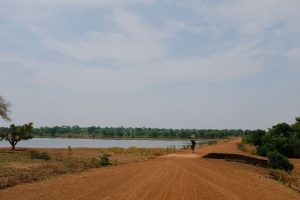
The following day, Ambassador Aniambossou and his delegation visited the Busa community, located near Wa, which is increasingly facing vulnerabilities due to climate change, such as drought. Busa, along with other districts in the Upper West, North East, and Savannah regions, stands to benefit from the AWMP’s initiatives aimed at rehabilitating dams and improving water access for agricultural use.
This visit underscores the French government’s and AFD’s commitment to advancing sustainable agricultural practices in Northern Ghana, bolstering the long-term resilience of local communities and the overall agricultural sector.
Source: Mofa

Apr 3, 2025
The Minister for Food and Agriculture, Hon. Eric Opoku on Thursday 3rd April, 2025 officially briefed the media on the Feed Ghana Programme (FGP), a nationwide initiative aimed at boosting Agricultural productivity while creating employment opportunities across the country.
The briefing took place at the Minister’s Conference Room and focused on expanding Agricultural production and ensuring a stable supply of raw materials to support the growth of agro-industries. According to Honourable Opoku, FGP is designed to generate thousands of jobs for youth and agripreneurs, contributing to Ghana’s economic transformation.
“Agriculture remains the backbone of our economy, and through the Feed Ghana Programme, we aim to create employment for thousands of Ghanaians in farming, processing, and agribusiness sectors,” the minister noted. The minister highlighted that Feed Ghana Programme will be officially launched by His Excellence John Dramani Mahama, on April 12th, 2025 at the Methodist School Park in Techiman, Bono East Region.
The initiative will provide farmers with Grains and Legumes Development Initiative, Advancement of Smart Agriculture ,Vegetable Development Project, Support for Institutional Farming, Revitalization of the Poultry Sector, Livestock Development Initiative, Feed the Industry Programme, Cocoa Industry Support, Cotton Production Expansion, Oil Palm Industry Development, Other Industrial Crop Initiatives, Investment in Infrastructure and Argo-Production Enclave and Innovative Agricultural Financing .Furthermore, the programme will strengthen value chains by ensuring that agricultural produce is efficiently processed into food products and industrial inputs, reducing post-harvest losses and enhancing food security.
With youth unemployment being a major challenge in Ghana, the FGP presents a pathway for young people to engage in agribusiness, from primary production to agro-processing and marketing.
Agriculture experts and industry leaders have applauded the programme, calling it a transformative step towards a more self-reliant and industrialized Ghana.
Source: Mofa

Nov 8, 2024
During the 40th National Farmers’ Day celebration on Friday, 8th November 2024, President Nana Addo Dankwa Akufo-Addo emphasized the critical need to build climate-resilient agriculture in Ghana, stressing that climate change poses an imminent threat to food security and agricultural productivity.
Under the theme “Building Climate-Resilient Agriculture for Sustainable Food Security,” the President outlined his administration’s proactive approach to address the effects of erratic rainfall, prolonged droughts, and rising temperatures on Ghana’s agricultural sector.
“Climate change is no longer a distant threat; it is a pressing reality that our farmers confront every day,” President Akufo-Addo declared.
He highlighted the vulnerability of Ghana’s agriculture to climate extremes, noting that these changes directly impact not only food production but also the livelihoods of millions of Ghanaians. Given the urgency of the situation, the President asserted that Ghana’s agricultural sector could not afford to wait for the crisis to worsen. “We must adopt proactive and innovative approaches to equip our farmers with the knowledge, tools, and resources they need to build resilience,” he stated.
Central to the government’s strategy for climate-resilient agriculture is the second phase of the Programme for Planting for Food and Jobs (PFJ 2.0), launched in August 2023. This initiative, designed to help farmers adapt to changing climatic conditions, includes comprehensive measures aimed at securing Ghana’s food supply for future generations. According to the President, one of the most critical components of climate-resilient agriculture is the availability of accurate, timely information.
To this end, the government has introduced the Ghana Agriculture and Agribusiness Platform (GhAAP), a digital tool that provides farmers with real-time updates on weather patterns, pest and disease surveillance, and food security trends.
Source: 3News