
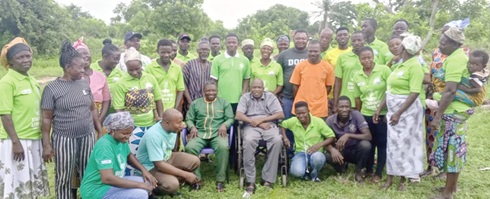
The Ministry of Food and Agriculture (MoFA), in partnership with the Forum for Natural Regeneration (FONAR), has launched a Striga control awareness campaign in the Upper East Region to tackle the growing threat of the parasitic weed to food production and rural livelihoods.
Striga, commonly known as witchweed, is a parasitic plant that attaches itself to the roots of cereal crops, including sorghum, millet, maize and rice, and deprives them of water and nutrients, negatively impacting yields.
In districts including Nabdam, Talensi, Bongo and Kassena-Nankana West, the infestation has become particularly severe, with some heavily affected farms recording crop losses of between 60 and 100 per cent.
The campaign on the theme: “Healthy Soils, Living Trees, Smart Practices Starve Striga – Regreen to Reclaim,” was held at Kparaboug in the Nabdam District, with funding support from Awaken Trees of Austria under the Farmer Managed Natural Regeneration for Women Empowerment and Livelihood Project (FMNR4WELIP).
The Executive Director of FONAR, Sumaila Saaka, said the weed had moved beyond being an ordinary agricultural pest to becoming a threat to household food security and rural incomes.
He explained that Striga could produce tens of thousands of seeds per plant, which could remain viable in the soil for many years, making the weed difficult to eradicate once a field became infested.
Mr Saaka said the situation was worsened by declining soil fertility, continuous cultivation of cereals, loss of tree cover, climate variability and the unintentional spread of Striga seeds through farm tools, animals, water runoff and contaminated crop residues.
He said the campaign was therefore designed to address both the weed and the underlying causes of land degradation.
Campaign
The campaign promotes Farmer Managed Natural Regeneration (FMNR), legume rotation and intercropping, application of compost and manure, early removal of Striga before seed production, and the use of tolerant crop varieties where available.
Mr Saaka said FONAR would provide farmer education materials, radio awareness messages, community sensitisation and school educational materials to improve the understanding of Striga and its control.
He said restoring soil health was central to the campaign because Striga thrived in degraded soils with low fertility.
“Lasting Striga control comes from combining several compatible practices consistently, season after season, across whole communities rather than single fields,” he said.
Targeting measurable results
The campaign seeks to ensure that at least 80 per cent of targeted farming communities can identify Striga, understand its life cycle and transmission pathways, and know at least three non-chemical control methods within the first year.
It also aims to increase the adoption of FMNR, legume rotation and soil fertility practices by 50 per cent in participating communities within two cropping seasons.
Over three years, the partners hope to achieve at least a 40 per cent reduction in Striga emergence and a 30 per cent reduction in associated cereal yield losses on participating and demonstration farms.
Mr Saaka said the Trans-Sahara WEFE Nexus Agroforestry initiative was being piloted in Tindongo and urged farmers to become “Striga control warriors” and called on district assemblies to include Striga management in their agricultural development plans.
Impact
The Nabdam District Crop Officer, Adams Musah, said Striga had become a serious threat to crop production in the district, with several farmers suffering substantial losses.
“Striga is a serious parasite that has affected crop yield in the Nabdam District, and we are grateful for this partnership with FONAR for this campaign,” he said.